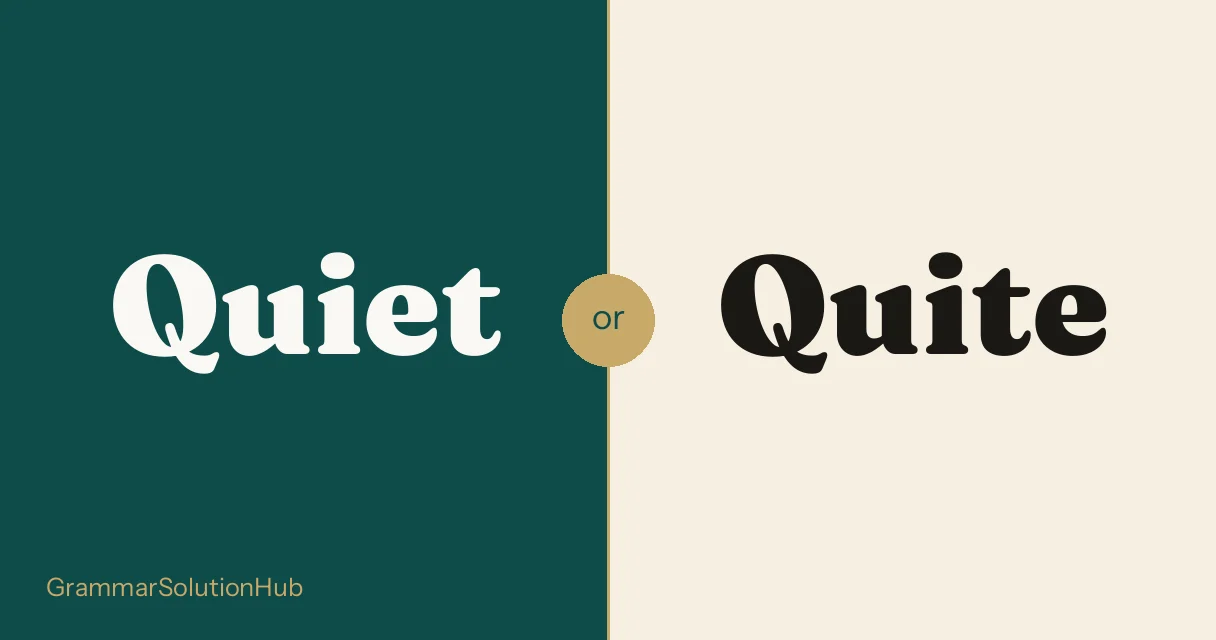
Quiet vs Quite: Which One Do You Need?
Quiet means making little noise. Quite means fairly or completely.
A quiet room. Quite good.
The test that settles it
This is usually a typing slip rather than a real confusion — the letters are simply transposed. Two syllables is quiet; one is quite.
“please be ___” → silent, so quiet.
“___ difficult” → fairly, so quite.
Quiet: little or no noise
An adjective, and also a noun and verb. Two syllables: KWY-et.
A quiet street.
She spoke in a quiet voice.
The crowd quietened down.
Swap in silent or calm. If either works, quiet.
Quite: fairly, or completely
An adverb with two almost opposite strengths. Before a gradable adjective it usually softens; before an absolute one it intensifies.
It was quite warm.
You are quite right.
Not quite finished.
Swap in fairly or completely. If either works, quite.
Side by side
| Quiet | Quite |
|---|---|
| Little noise | Fairly, completely |
| Adjective, noun, verb | Adverb |
| Two syllables | One syllable |
| A quiet word | Quite a lot |
The exception
Quite good in British English usually means moderately good, and can even be faint praise. Quite impossible means completely impossible.
The rule is that gradable adjectives get the weaker sense and absolute ones the stronger. American English leans towards the strong sense throughout, which is a common source of mild transatlantic misunderstanding.
Where people get it wrong
| Incorrect | Correct | Why |
|---|---|---|
| The library was very quite. | The library was very quiet. | Noise. |
| It is quiet expensive. | It is quite expensive. | Fairly. |
| quietly quite | perfectly quiet | The adverb has run in twice. |
| Keep quite about it. | Keep quiet about it. | Say nothing. |
Practice — choose the right word, then check yourself.
- The village is very ___ at night.
- That was ___ unnecessary.
- She asked for ___ during the exam.
- I am not ___ ready.
- It has been ___ a week.
Show the answers
1. quiet 2. quite 3. quiet 4. quite 5. quite
Frequently asked
Why is this mistake so common?
Because it is a finger slip, not a knowledge gap. Spellcheckers pass both, so it survives proofreading.
What about quit?
A third word — to stop or leave. One syllable, no e in the base form.
More words people confuse